
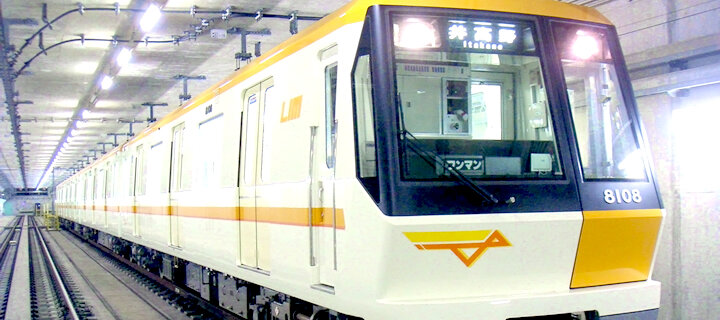
As an urban public transportation system, the subway serves a vital means of transportation in the lives of citizens, promotes regional development and the revitalization of cities, and creates a more replete urban infrastructure. Furthermore, because subways are built primarily beneath roads, they make effective use of land, produce little noise, and have no impact on the urban landscape, which is why they are being developed around the world as a system well-suited to creating appealing cities. However, subway construction requires long-term planning and large sums of money, and the current reality is that development has progressed slowly in individual cities in recent years due to rising construction costs.
This led to demand for a low-cost subway of the right scale to match transportation needs, which in turn has led to the development of the Linear Metro, which uses a linear motor drive system.
Subways in Japan have already been built and operated as the backbone of transportation in major cities, and further development will be implemented going forward. Meanwhile, in regional hub cities, traffic congestion in city centers has intensified with the rise in automobile traffic, and the environment has deteriorated due to noise and exhaust fumes; and while the introduction of public transportation has been studied as a solution, it has proven difficult to achieve due to such challenges as choosing a system, selecting a construction site, and securing construction funding.
The low-cost Linear Metro, which was researched and developed for practical implementation over three years starting in FY 1985, is the optimal system for use as a semi-main line or branch line in major cities and as a main line in regional hub cities.
In order to promote the construction of the linear motor-driven Linear Metro as public transportation in major cities and regional hub cities, the Japan Subway Association established the Linear Motor-Driven Subway Promotion Headquarters within the Association in October 1988 (renamed the Linear Metro Promotion Headquarters in May 1999), and has been conducting promotional activities not only in major cities but in cities considering the introduction of public transportation and those expected to do so in the future.
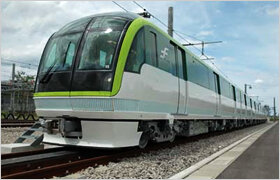
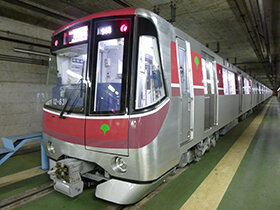
| 1979 | Investigation and Study of Small Subway Systems ● "A Study on the Structure of Subways of Appropriate Scale for Urban Transportation Demand (Standard Small Subway System)" The Japan Subway Association |
| 1981 | Development of technology commences ● "Study of Small-Profile Subway Trains Using a Linear Motor System" / "Study of Guideways for Linear Motor Transit Systems" The Japan Railway Engineering Association |
| 1984 | Surveys aimed at practical use commence ●"Research for the Study on the Practical Application of the Linear Motor-Driven Small Subways" Ministry of Transport / The Japan Subway Association |
| 1985 | Promotion of research and development for practical implementation ● "Research and Development for Low-Cost Subway (Practical Study of the Linear Motor-Driven Small Subway)" Ministry of Transport / The Japan Subway Association |
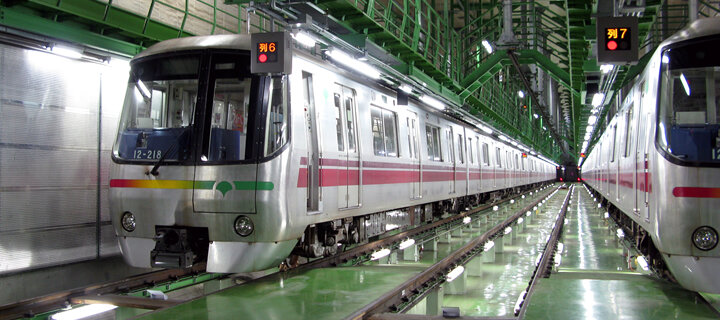
| 1988 | Demonstrated practical implementation of the Linear Metro. Decision made to adopt the Linear Metro for the Osaka Municipal Subway Tsurumi-ryokuchi Line in September 1988. Decision made to adopt the Linear Metro for Tokyo Toei Subway Line 12 in December 1988. |
| 1990 | Osaka Municipal Subway Tsurumi-ryokuchi Line opened between Kyobashi and Tsurumi-ryokuchi in March 1990. |
| 1991 | Tokyo Toei Subway Line 12 opened between Nerima and Hikarigaoka in December 1991. |
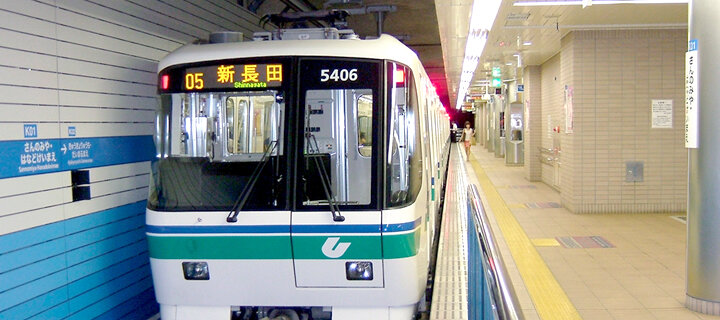
| 1993 | Decision made to adopt the Linear Metro for the Kobe Municipal Subway Kaigan Line in April 1993. |
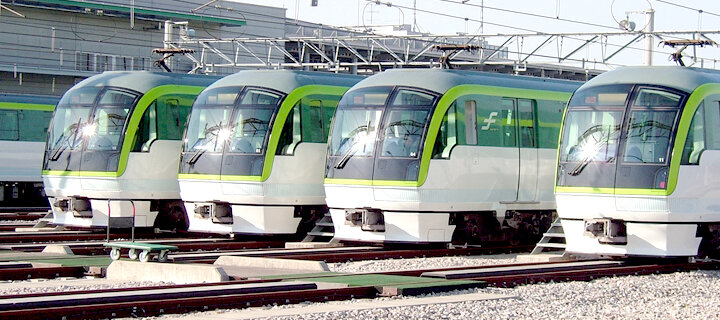
| 1994 | Decision made to adopt the Linear Metro for Fukuoka City Subway Line 3 in January 1994. |
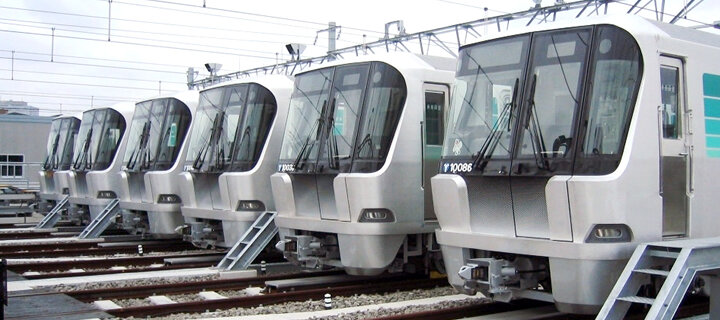
| 1996 | Decision made to adopt the Linear Metro for Yokohama Municipal Subway Line 4 in March 1996. Osaka Municipal Subway Nagahori Tsurumi-ryokuchi Line opened between Shinsaibashi and Kyobashi in December 1996. |
| 1997 | Osaka Municipal Subway Nagahori Tsurumi-ryokuchi Line opened between Taisho and Shinsaibashi, and between Tsurumi-ryokuchi and Kadoma-minami in August 1997. Tokyo Toei Subway Line 12 opened between Shinjuku and Nerima in December 1997. |
| 2000 | Toei Oedo Line opened between Shinjuku and Kokuritsu-kyogijo in April 2000. Toei Oedo Line opened between Tochomae and Kokuritsu-kyogijo in December 2000. |
| 2001 | Kobe Municipal Subway Kaigan Line opened between Shin-Nagata and Sannomiya-Hanatokei-mae in July 2001. |
| 2005 | Fukuoka City Subway Nanakuma Line opened between Hashimoto and Tenjin-minami in February 2005. |
| 2006 | Osaka Municipal Subway Imazatosuji Line opened between Itakano and Imazato in December 2006. |
| 2008 | Yokohama Municipal Subway Green Line opened between Hiyoshi and Nakayama in March 2008. |
| 2015 | Sendai City Subway Tozai Line opened between Yagiyama Zoological Park and Arai in December 2015. |
| 2023 | Fukuoka City Subway Nanakuma Line opened between Tenjin-minami and Hakata in May 2023. |
Kawasaki Railcar Manufacturing Co., Ltd.
Kyosan Electric Manufacturing Co.,Ltd.
Chuo Fukken Consultants Co.,Ltd.
Tonichi Engineering Consultants, Inc.
Toho Electrical Construction Co.,Ltd.
Nippon Densetsu Kogyo Co.,Ltd.